Why charts can differ between calculation methods.
Tropical (Of-Date) vs Tropical (J2000) reference frames explained.
If you've been studying your Human Design chart, you may have noticed something called Tropical (J2000) or seen a small J2K indicator. This page explains what it means and why it matters for the accuracy of your chart.
Tropical (J2000) is available with a Genetic Matrix Pro subscription

Genetic Matrix offers multiple calculation methods. We provide tools for exploration, not prescriptions for what you should believe. Choose the method that resonates with you, compare your charts, and decide for yourself.
Tropical (J2000) is a calculation option that uses a fixed astronomical reference frame. This page explains what that means, how it differs from traditional Tropical calculations, and why you might want to explore it alongside your existing chart.

Traditional seasonal zodiac
Fixed reference frame
Star-based zodiac
Includes Ophiuchus
Kanatas ayanamsa
Chimenti ayanamsa
Midpoint ayanamsa
Based on lunar nodes
True node variant

The J2K icon marks activations where the decoded value differs between Tropical (Of-Date) and Tropical (J2000), or where it falls within a small threshold of a boundary that could flip under a different method.
This lets you instantly see which parts of your chart might look different under J2000 calculations, without having to switch back and forth between methods.

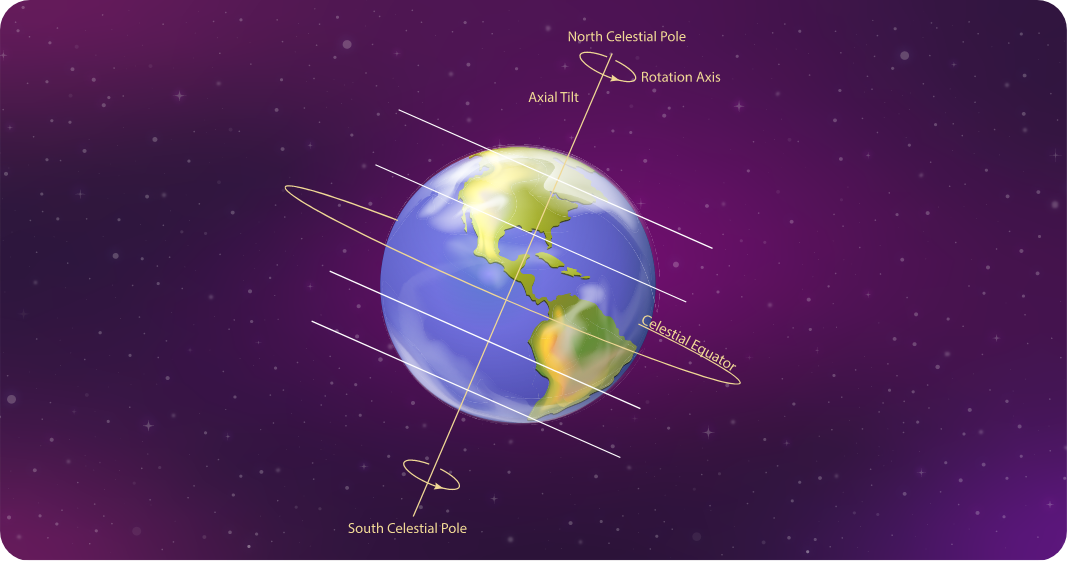
Earth spins on its axis like a top. But just like a spinning top that's winding down, Earth's axis doesn't point in a fixed direction - it slowly traces a circle in space over approximately 26,000 years. This is called axial precession.
Everyday Example
Picture a spinning top on a table. As it spins, the top doesn't stay perfectly upright - it slowly wobbles around in a circle. Earth does exactly this, just very slowly. The North Pole, which currently points toward Polaris (the North Star), pointed toward a different star thousands of years ago and will point toward yet another star thousands of years from now.
Layered on top of precession is a smaller, faster wobble called nutation. While precession is the big, slow circle, nutation is a slight nodding or oscillation that completes its cycle roughly every 18.6 years. This is primarily caused by the gravitational pull of the Moon on Earth's equatorial bulge.
Everyday Example
Think of someone carrying a full cup of coffee while walking. There's the big motion of walking forward, but there's also a smaller, quicker sloshing of the coffee with each step. Precession is the walking; nutation is the sloshing. Both affect where the coffee (or in our case, the precise pointing of Earth's axis) actually is at any given moment.
Beyond precession and nutation, Earth experiences other small motions: gravitational tugs from other planets, slight variations in the shape of Earth's orbit, and even the redistribution of mass on Earth's surface can affect our planet's orientation. These are tiny effects, but they exist.
Why Does a Fraction of a Degree Matter?
Human Design subdivides the zodiac into very fine steps (gate, line, color, tone, base). A difference of even 0.3 - 0.6 degrees, the scale you get when comparing a fixed J2000 reference to an equinox-of-date reference across recent decades, can shift the decoded result.
1 Gate = 360 / 64 = 5.625 degrees
1 Line = 5.625 / 6 = 0.9375 degrees
1 Color = 0.9375 / 6 = 0.15625 degrees
1 Tone = 0.15625 / 6 = 0.026 degrees (approx 1 min 34 sec)
1 Base = 0.026 / 5 = 0.0052 degrees (approx 18.75 sec)
So a shift of ~0.3 degrees (2000 - 2026 scale) can plausibly change Colors and sometimes Lines, and it will very often change Tone/Base-derived outputs if you use them.

When calculating a Human Design chart, we need to know exactly where the planets were at the moment of birth. This requires a coordinate system - a way of defining positions in space.
Uses the equinox of date as the zero point for tropical longitude (0 degrees Aries). In other words, longitudes are referenced to the equinox at the time of the chart (mean or apparent, depending on system).
Uses the mean equinox/ecliptic of J2000.0 as the reference. Longitudes are expressed relative to a fixed epoch rather than equinox-of-date values for the same birth moment.
Everyday Example
Different coordinate datums can assign different numeric coordinates to the same physical location. The location hasn't moved - only the reference used to describe it has changed. Likewise, planets don't "move" when we switch between Of-Date and J2000; only the numbers used to express their longitudes change.
J2000/ICRS-style reference frames are widely used in modern astronomy, spacecraft navigation, and many ephemeris datasets. Astrology and Human Design software may convert those positions into an equinox-of-date tropical zodiac as the most common convention. Because Human Design uses very fine subdivisions in HD practice, both approaches are well-defined; they can produce different decoded outputs.

"Doesn't the traditional method capture what was actually happening at the moment of birth? If Earth was wobbling, shouldn't our calculations reflect that wobble? Isn't the 'of date' approach more accurate because it tracks reality?"
This is a reasonable question, and it deserves a thoughtful answer.
Here's the thing: the planets don't actually move when we change reference frames. Mars was exactly where it was at your birth, regardless of which coordinate system we use to describe its position. What changes is how we describe that position - what numbers we assign to it.
"Let's describe planetary positions relative to where Earth's axis is pointing right now, wobbles and all."
"Let's describe planetary positions relative to a fixed reference point, so we have a stable standard that doesn't shift with Earth's motions."
Neither approach is more "real" than the other - they're different conventions for describing the same physical reality. The question is which convention produces more consistent, meaningful results for Human Design calculations.
Everyday Example
Imagine you're trying to record the exact location of a rare bird sighting. You could describe it relative to where you're standing ("20 meters to my left"). But if you're on a slowly rotating platform, "to my left" means something different depending on when you take the measurement. Alternatively, you could use GPS coordinates - a fixed reference system that doesn't depend on where you're standing or which way you're facing. The bird is in the same place either way. The question is just: which description is more useful and consistent?

This page isn't about reinterpreting Human Design's origins or putting words in anyone's mouth. It simply explains that calculating planetary positions can use different astronomical reference conventions (e.g., equinox-of-date vs. a fixed epoch like J2000), which can change fine-grained decoding results. We encourage method-by-method comparison and exploration.
Tropical (Of-Date) and Tropical (J2000) are both valid tropical conventions. They differ in whether the equinox reference is updated for the date or held fixed to the J2000 epoch, so fine-grained Human Design decoding can differ.
We Can't Speak for Ra
Anyone who claims to know definitively what Ra would have thought about J2000 is speculating. Ra isn't here to ask, and putting words in his mouth isn't something we're interested in doing. What we can do is provide tools and let you experiment. Generate your chart both ways. Compare the results. See which resonates with your lived experience. That's the Human Design way - don't take anyone's word for it. Test it yourself.
Human Design has always evolved as better tools became available. Early charts were calculated by hand. Then came basic software. Then more sophisticated ephemeris calculations. J2000 is simply the next step in that evolution - using the same astronomical standard that powers modern spacecraft navigation and observatory calculations.
The question isn't what Ra would have thought. The question is: does this produce a chart that more accurately reflects who you are? Only you can answer that.

A Human Design chart divides the 360-degree zodiac into 64 Gates, with each Gate spanning 5.625 degrees. But the system goes deeper: each Gate contains 6 Lines, each Line contains 6 Colors, each Color contains 6 Tones, and each Tone contains 5 Bases.
By the time you reach the level of Base, you're dividing each Gate into 1,080 tiny slices. At this resolution, even small positional differences between calculation methods can produce different results.
The J2K marker indicates activations whose decoded result differs between Tropical (Of-Date) and Tropical (J2000).

When comparing Tropical (J2000) to traditional Tropical calculations, differences tend to appear at the finer levels first, but can cascade upward:
| Level | What It Affects |
|---|---|
| Base | The Entry Frequency into your cognitive architecture |
| Tone | The inner layer of the crystals of consciousness |
| Color | The exit frequency - Motivation or Determination. The Not-Self emerges when a distorted exit frequency allows the mind to control decisions |
| Line | Could affect your Profile - the role you play in life |
| Gate | A shift to a different Gate, potentially changing channels |
| Center | A new channel could define or undefine an energy center |
| Type | In some cases, a center change could shift your Type entirely |
Most charts will show differences at the Color or Tone level. Some will show Line differences. Occasionally, when a planet sits in a 6th Line near the boundary of the next Gate, a Gate shift can occur - and that's when Type or Profile might change.

Here's how the same birth data can produce different results:
| Element | Traditional Tropical | Tropical J2000 |
|---|---|---|
| Profile | 6/2 | 1/3 |
| Sun Gate | Gate 4, Line 6 | Gate 63, Line 1 |
| Channels | 4-63, 47-64, 11-56 | 47-64, 24-61, 11-56 |
| Defined Centers | Head, Ajna, Throat | Head, Ajna, Throat |
Notice how the Profile shifted from 6/2 to 1/3, two completely different life paths. The channel configuration also changed, which would alter how energy flows through the design.

An important clarification: Tropical (J2000) is still a tropical system. The zodiac remains anchored to the seasons, with the vernal equinox defining 0 degrees Aries. This is the framework Ra Uru Hu used for Human Design.
Tropical (J2000) differs from traditional Tropical only in the stability of the reference frame used to calculate planetary positions - not in where the zodiac wheel starts or how it relates to Earth's seasonal cycle.
This is distinct from the sidereal options we also offer (Sidereal, 13-Sign Sidereal, True Sidereal variants), which anchor to the fixed stars and shift the entire wheel by approximately 24 degrees. If you're an astrologer who works with sidereal and wants to explore Human Design through that lens, we offer those options. Tropical (J2000) is a different kind of option - a refinement of tropical precision rather than a shift to a different zodiacal framework.

Ready to try it? Here are three ways to access Tropical (J2000) in your Genetic Matrix account:
Select "Tropical (J2000)" from the calculation method dropdown on any chart. Switch back and forth between methods to compare your results instantly.
Go to Settings, then J2000 Notification Settings and toggle it On. A J2K icon will appear next to activations that sit near key decoding boundaries, where results are more likely to change when you switch methods.
Choose Tropical (J2000) as your permanent calculation method in Settings. All your charts will generate using this method until you change it.
We encourage you to explore. Generate your chart with traditional Tropical, check which activations show the J2K flag, then switch to Tropical (J2000) and see what shifts. Consider whether the new information resonates with your experience.

Reference chart comparisons will be displayed here, showing examples where calculation methods produce differences at the Color, Line, or Gate level.
"Different reference frames can describe the same sky. What changes is the coordinate system, not the planets."

Not necessarily. Tropical (Of-Date) and Tropical (J2000) are two ways of expressing tropical longitude using different reference epochs. Because Human Design decoding uses precise boundaries (Gate/Line/Color/Tone/Base), some people will see meaningful changes, especially in Variable, while others may see little to none. The only way to know is to compare both methods on the same birth data.
Mostly tradition and tooling. Human Design software has historically used Tropical (Of-Date), and many schools teach what Ra's original materials and early calculators used. Meanwhile, J2000 is a common reference epoch in modern astronomical catalogs and coordinate systems, so some software and practitioners prefer a fixed-epoch tropical frame for consistency. It's less about one being "right," and more about which convention you choose to anchor your decoding.
Use one method consistently, then evaluate your experience. If you're practicing Human Design as commonly taught, Tropical (Of-Date) is the usual baseline. If you want to explore a fixed-epoch tropical reference, try Tropical (J2000) - but avoid mixing and matching individual outputs between methods.
Ra rejected Sidereal. Sidereal zodiacs shift the zodiac against the stars by an ayanamsa (roughly ~24 degrees today, depending on the tradition). Tropical (Of-Date) anchors Aries to the equinox of the moving reference due to precession. Tropical (J2000) anchors Aries to the J2000 equinox (a fixed-epoch tropical frame). Same tropical concept - different reference epochs, so decoded outputs can differ at the fine-grained level.
The J2K icon indicates an "edge case" - a planetary activation that sits close to a boundary. When you enable J2K Notifications, these icons appear on your traditional Tropical chart to flag positions that are likely to change if you switch to Tropical (J2000).
If any of your planetary placements fall near boundaries between Lines or Gates, you'll likely see some difference - whether that's at the Base, Tone, Color, Line, or occasionally Gate level. If your placements fall solidly in the middle of Lines, the two methods may produce identical results for those positions. The J2K notification feature helps you see at a glance which activations might shift.
If you're tracking transits, using J2000 ensures consistency with modern ephemeris data. Your natal chart and transits should use the same reference frame for accurate analysis. Mixing methods can introduce discrepancies.
Genetic Matrix offers Tropical, Tropical (J2000), Sidereal, 13-Sign Sidereal, three True Sidereal variants (Kanatas, Chimenti, Midpoint), and two Draconic options. Each serves different purposes and philosophical frameworks. Astrologers coming to Human Design from sidereal or Vedic traditions may want to explore those options. Tropical (J2000) is specifically for those who want to stay within the tropical framework while using a fixed astronomical reference.
No. We're saying there's more than one valid way to calculate a chart, and we believe in giving you options. The traditional Tropical method remains available. Tropical (J2000) is an additional tool for those who want to explore it. We're not here to tell you what to believe - we're here to give you the tools to find out for yourself.
Generate your Human Design chart using Tropical (J2000) and compare it with your traditional Tropical chart to see what changes for you.


