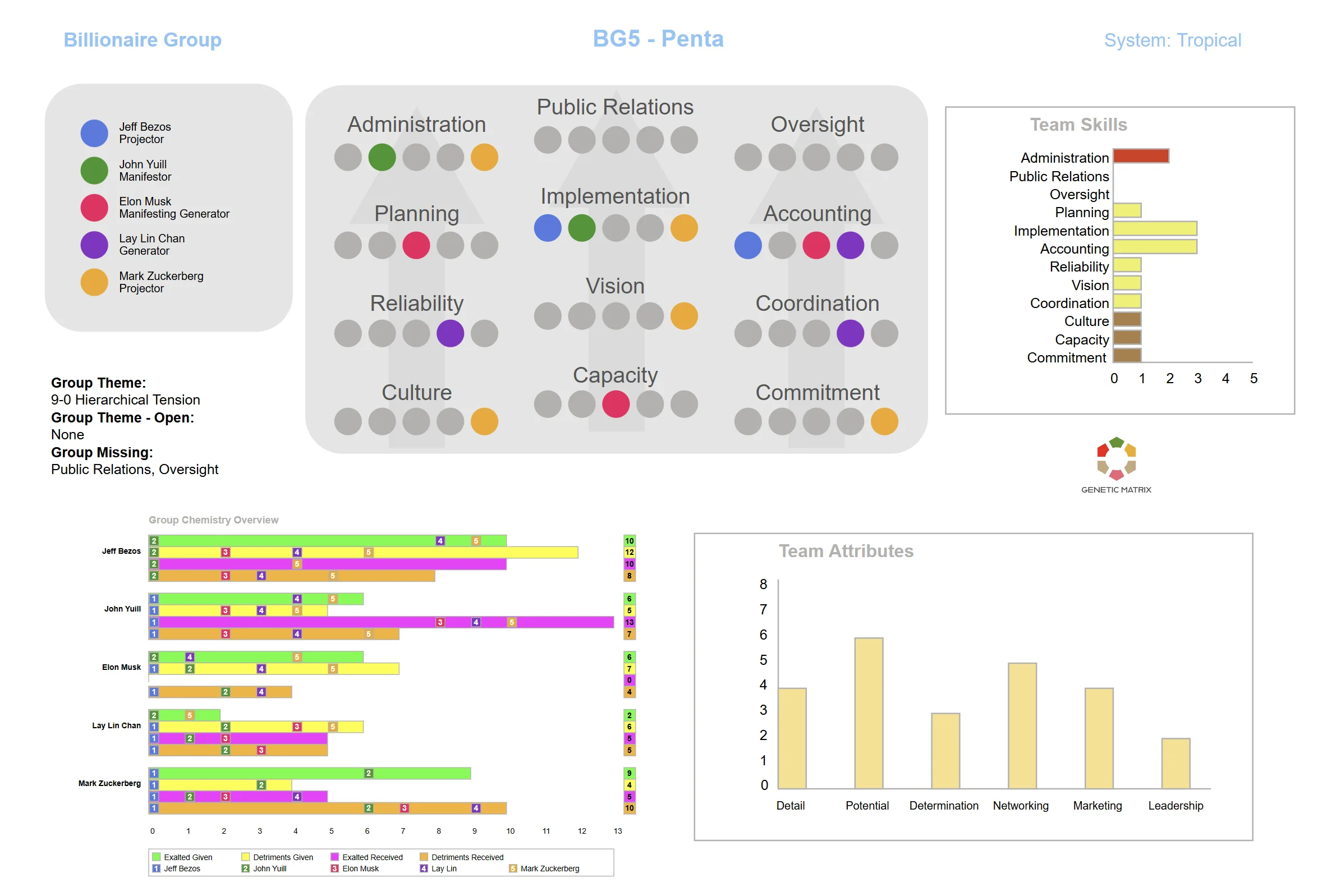
BG5 (Business Group 5) is the application of Human Design's Penta mechanics to small business teams. The Penta is a transpersonal energy form that emerges when 3 to 5 people work together within auric contact. It operates the same way whether the group is a family or a work team. BG5 uses business-oriented terminology to make these mechanics more accessible in a professional context.
In BG5, individual Human Design concepts are translated into business language. Types become Career Types, Centers become Business Functions, Channels become Strengths, and Gates become Skill Sets. The underlying mechanics remain the same, but the framing shifts to focus on team productivity, role alignment, and group dynamics in the workplace.
Career Types
Types in Business Language
BG5 translates Human Design Types into Career Types. Classic Builders (Generators) provide sustainable workforce energy. Express Builders (Manifesting Generators) combine building energy with initiative. Advisors (Projectors) guide and manage the energy of others. Innovators (Manifestors) initiate and bring things into being. Evaluators (Reflectors) reflect the health of the team.
The Small Business Penta
3 to 5 People in a Team
When 3 to 5 people work together and are within auric contact, the Penta activates and begins conditioning each member to serve specific functional roles. The Penta has its own set of Channels that represent core business functions: managing resources, communicating strategy, executing tasks, and maintaining team cohesion. The team's composition determines which functions are naturally covered.
Business Language for Design Mechanics
Strengths, Skill Sets, and Skill Attributes
In BG5, Channels are called Strengths, Gates are called Skill Sets, and Lines are understood as skill attributes. These terms translate Human Design mechanics into business language without changing the underlying structure. When a team member's design activates a particular Gate or Channel within the Penta, that person contributes a specific business capacity to the group. Where activations are missing, gaps can appear in how the team functions, often requiring compensation through hiring, outsourcing, or greater awareness.
Team Gaps
Unfilled Functions
Gaps in the Business Penta occur when no team member's design activates a required Skill Set. These gaps create vulnerability. The team may struggle with the function that gap represents, often by overcompensating in ways that affect the balance of the Penta, or individual members may be conditioned to fill a role that does not match their natural strengths. Identifying gaps helps explain where the team is likely to experience distortion or instability.
Alpha and Influence
Leadership Mechanics in the Team
The Penta has its own leadership mechanics. The Alpha role is not necessarily held by the person with the highest job title. It is determined by who carries the most defined Penta Channels. Understanding this helps explain why some teams have power dynamics that do not match the formal hierarchy.
BG5 vs. Individual Human Design
The Shift from Individual to Group
In individual Human Design, the focus is on living your design through your own Strategy and Authority. In BG5, the focus shifts to how individuals contribute to the team's mechanical structure. A person may be highly effective individually but poorly suited for a specific role within a particular Penta configuration. BG5 helps align individual strengths with team needs.
Hiring with BG5
Strategic Team Composition
BG5 can inform hiring decisions by identifying which Skill Sets are missing from a team. Rather than hiring based solely on resume or personality, BG5 points to which mechanical gaps need to be filled. This can improve team function by ensuring the group's core competencies are covered by people who naturally carry the required Penta Gates or Channels.
Meeting and Communication Dynamics
How Teams Process Information
The Penta's Zones determine how information flows within the team. Some configurations create natural efficiency in meetings and decision-making. Others create bottlenecks or blind spots. Understanding the team's communication mechanics helps structure meetings and workflows in ways that align with the group's natural processing style.
Note
BG5 uses different terminology than standard Human Design, but the underlying mechanics are identical to the Family Penta. The same transpersonal form that shapes family dynamics also governs small team dynamics in the workplace.