| What Is Animal Design?
Every animal has a design. A unique energetic blueprint encoded in the moment of birth, just like yours. But where your Human Design chart operates through 64 gates, 9 centers, and a complex web of channels and circuits, your animal's chart is fundamentally different. Simpler. More primal. And in many ways, more powerful in its directness.
The Mammalian Design System operates through just 15 gates arranged across 5 centers, organized into three distinct groups. There is no Solar Plexus center. No Ego. No mind running the show. What remains is a pure, unfiltered expression of the animal's nature: its instincts, its needs, its fears, its capacity for connection.
And here's what changes everything: when you understand your animal's design, you stop projecting human qualities onto them. You stop trying to make the fierce guard dog into a lap pet. You stop wondering why your cat ignores you or why your horse won't accept a saddle. You see the animal for who it actually is, and in that seeing, the relationship transforms.
Key Insight
Mammals share our quality of personality crystal. The only difference is the design. They don't have a neo-cortex. They don't have the same mechanical tools. But the personality is there. Anyone who has lived with an animal knows this.
The Lunar Calculation
Your Human Design uses the Sun for its calculations: a retrograde of 88 degrees of solar movement to find your Design (unconscious) activation. Animal Design works differently. The Moon rules all lower life forms. Instead of 88 solar degrees, the animal's design calculation goes back 88 lunar degrees, approximately six to seven days before birth.
This means the personality enters the animal's body roughly a week before it's born, compared to roughly three months for humans. The calculation produces a set of planetary positions, but only activations that fall within the 15 mammalian gates matter. Everything else is discarded. The result is a chart that can range from completely open (no activations at all) to surprisingly defined, with channels, centers, and a clear energetic Type.
And here's the practical part: you don't need an exact birth time. Human charts show Base, Color, and Tone - fine details that shift quickly and require precise birth times. Animal charts don't. With only 15 gates in the matrix, the chart moves far more slowly throughout the day than a human chart. Most pet owners know the date their animal was born. That's usually enough.
And Genetic Matrix goes a step further. Every animal chart automatically generates a Birth Time Range chart that shows your animal's design at 3-hour intervals across the entire birth day. You can see at a glance what changed and what stayed constant. In many cases, the Type and key activations remain the same all day - so even without knowing the birth hour, you have a reliable chart.
| The 15-Gate Mammalian Matrix
The mammalian chart contains 15 gates organized into three groups of five. Each group is anchored by a Cross-Species Portal Gate - a special gate that bridges the animal world and the human world. These portal gates are how animals connect with us, and they define the fundamental nature of that connection.
Territory Group
The foundation of survival: where they live, what they eat, and how safe they feel. This is where the most conflict arises between pets and their humans.
Territory
Fear
Fierceness
Maturity
Freedom
Portal Gate: 19 - The animal as resource.
Alpha Group
The working intelligence: an animal's capacity to learn, to lead, to be trained, and to connect with the human concept of time and future.
Alpha
Presence
Awareness
Direction
Individuality
Portal Gate: 62 - The animal as worker.
| The Territory Group
Territory is where the most difficulty arises between mammals and their human companions. This is primal. Non-negotiable. An animal with strong territorial activations needs its territorial reality respected, or you will have problems. The cat that sprays, the dog that guards its food bowl, the horse that won't share its stall - these behaviors are not misbehavior. They are design.
Gate 19 - Territory Portal Gate
The foundational territorial gate and a cross-species portal. Any animal with Gate 19 is deeply territorial. A male cat with this gate will mark every piece of furniture in the house. A dog with Gate 19 will perceive anything near its food bowl as a threat to its resources. This is the ancient bargain gate: humans provide safe territory and food, and in exchange the animal accepts domestication. It's the reason sheep stay behind fences and cows accept their fields.
Gate 38 - Fierceness
Pure energy. A dog with Gate 38 can be a very fierce creature. You don't want to surprise them. Their bark is often worse than their bite, but the fierceness is real. If you mistreat an animal with Gate 38, you have an enemy for life. It will never forget the abuse and will look for its revenge. But they can also be gentle and sweet. The fierceness is their shield, their way of maintaining integrity.
Example
A German Shepherd with Gate 38 is a natural guard dog. That fierceness is hardwired. Don't try to train it out of them. A dog with the right territorial activations IS a working dog. Don't expect it to be a lazy lap pet, because it never will be.
Gate 28 - Fear
Fear is the root of awareness in mammals. The 28th Gate is the key to mammalian intelligence. Everything about individuality in animals is acoustic. They are very sophisticated in what they hear, and the 28th Gate is the root of that acoustic ability. An animal with Gate 28 is always listening, always on alert. A shudder goes through them at unexpected sounds. But out of that fear comes learning: the animal with Gate 28 is an intelligent creature because its fear forces it to pay attention.
Gate 53 - Freedom
This is the only gate in mammals connected to depression. An animal with Gate 53 cannot be confined. This is not a dog you can chain. Not a cat you can lock in your apartment while you go to work all day. If you deny freedom to an animal with Gate 53, you create depression. The 53rd Gate is the beginning of the maturation cycle; this animal needs to be as wild as possible to go through its natural process.
Gate 42 - Maturity
The other side of the maturation cycle. Animals with Gate 42 need to complete their full life process. If you sterilize an animal with Gate 42, you create lifelong depression because the animal can never complete its maturing cycle. A cat with Channel 53/42 that is never allowed to hunt will be depressed. And because your auras intermix, that depression enters your life too. You can sterilize animals that don't have Gate 42 without this consequence, but for those that carry it, the cost is enormous.
The Metamorphosis Group
This is where friendship lives. The Channel 12/22 in Human Design connects human emotional spirit to the mammalian world. This isn't the animal as resource or worker - this is the animal as friend, as companion, as an equal consciousness in a different form. If you grew up on a farm and one piglet from the litter has Gate 12 and you have Gate 22, that piglet is your friend. You don't sacrifice your friend for dinner.
Gate 12 - Metamorphosis
The Gate of Caution. An animal with Gate 12 approaches friendship slowly and carefully. If you try to befriend a wild animal with this gate, the process can take months. One wrong move and it's over. They won't come back. But if trust is established through patience and gentleness, the bond that forms is a true relationship between two distinct alien consciousnesses. This is where the wolf became the dog. Not through dominance, but through the slow, cautious alchemy of the 12/22 connection.
Gate 27 - Herding
An animal that keeps things around it. This animal is not going to be happy alone. It needs community. Animals with Gate 27 will herd other species just as successfully as their own. This is the herding dog that rounds up children at the park. The cat that follows you from room to room. They need that sense of togetherness.
Gate 50 - Bonding
Highly sexual mammals. Animals with Gate 50 are the most successful breeders. The livestock industry pays enormous prices for the semen of animals with strong breeding capacity, and Gate 50 is where that lives. But an animal with Gate 50 kept in captivity will exhibit behaviors that go along with the need to breed, and those behaviors are not always pleasant for its human companion.
Channel 5/15 - Rhythm
The most powerful channel in the mammalian world. Gate 5 is fixed patterns: this animal expects to be fed at the same time every day. Disturb its routine and it becomes deeply agitated. Gate 15 is diversity: this animal can adjust to any rhythm as long as its needs are eventually met. But an animal with the full Channel 5/15 is something else entirely. It controls your entire life. When you get up, when you go to sleep, when you eat. Its aura pulls everyone into its timing. If you have a screaming baby, put the Channel 5/15 cat in the baby's room. As soon as the cat falls asleep, the baby falls asleep. Instantly. These animals condition the pattern around them.
| The Alpha Group
The working intelligence of the animal. For most of human history, civilization depended on animal labor. Horses, oxen, sled dogs, herding companions. Industrialization ended that role, and for the first time in history, most animals are kept simply for pleasure. But the Alpha group reveals something profound: these animals still need a job.
Gate 62 - Alpha Portal Gate
The worker gate. Animals with Gate 62 have the cross-species potential for a special kind of conditioning: learning about the future. Mammals are existential creatures, living purely in the now. But through Gate 62, humans teach them about time. The sound of the can opener, the jingle of the leash, the car pulling into the driveway - the animal learns to anticipate the future through pattern recognition. An animal with Gate 62 that isn't given something to do becomes deeply unfulfilled.
Gate 57 - Awareness
The root of mammalian intelligence. All mammals are acoustic creatures, and Gate 57 is where that acoustic sophistication lives. Animals with Gate 57 don't need to be trained - they learn from what they hear. The dog that brings you the phone when it rings. The cat that comes running at the sound of your voice. They associate sounds with phenomena naturally. If you growl at a puppy with Gate 57 when it misbehaves, that sound stays with it for life.
Channel 8/1 - Inspiration
The mutative channel. Channel 8/1 animals are the oddballs, the freaks of the litter, the ones who don't fit in. But they're also the ones who drive evolution. The monkey who takes its potato to the beach and washes it in saltwater, and within months every monkey on the island is doing the same thing. These animals lead by example, setting new directions for the group. But mutation isn't always welcome: the Channel 8/1 animal can also be the runt that the mother abandons.
Important Distinction
Don't confuse Channel 8/1 with Gate 62. The Alpha (Gate 62) knows the patterns and leads the pack. The Channel 8/1 animal finds something outside the pattern. The Alpha recognizes that potential and uses it. They are different forces.
| The Six Line Keynotes
Just as in Human Design, each line carries a distinct quality. But the mammalian line keynotes are different from the human ones, reflecting the more primal reality of animal existence. The Lower Trigram (Lines 1–3) represents animals that are inward, not easily equipped for the outsider. The Upper Trigram (Lines 4–6) represents transpersonal animals that integrate more easily with others and with humans.
Line 1: Stealth
The purest expression of the gate's nature. These animals are insecure, careful, cautious. They wait a long time before making any move, checking the environment for safety. If a pit bull has a 1st Line, it will eventually fulfill its nature. Stealth is survival at its most fundamental.
Line 2: Mystery
The visible animal. 2nd Line creatures can be seen, which makes them vulnerable. They are the ones standing in the forest when the predator comes. Skittish, unpredictable. The dog you think is sweet that suddenly bites you. Something inside them genetically recognizes their vulnerability.
Line 3: Struggle
Trial and error. In nature there can't be many mistakes, so 3rd Line animals tend to be stubborn. Try to paper-train a 3rd Line dog and it never works. Maybe two years later they finally get it. But these are the discoverers, the ones who find things other animals miss.
Line 4: Influence
The most influential line in the mammalian world. Fixed and powerful. 4th Line animals take control: they lead hierarchies, dominate social structures. Having a 4th Line pet may not be easy because they are very fixed in their ways, but their transpersonal nature means you can work things out together.
Line 5: Challenge
The projection field. 5th Line animals attract attention and get projected on. You go to the shelter, look at the kittens, and say "oh, this one will make a wonderful pet." That may or may not be true. It's simply your projection. 5th Line animals can end up in fights they didn't start because others project fierceness or challenge onto them.
Line 6: Separation
The bridge between mammal and human. 6th Line animals stand apart from the group. They are the one from the litter that isn't playing with the others, the animal you look at and wonder "what are they thinking?" There's an anti-social quality, but also a potential for a metamorphic connection that transcends the normal animal-human relationship.
| The Three Cross-Species Portal Gates
These three gates are the bridges between the animal world and the human world. Each one defines a fundamentally different kind of relationship. When a mammal has one of these gates activated, it is designed to meet humans. In one way or another in its life, whether wild or domesticated, it will find its way to a human encounter.
And for you as a human: if you carry Gate 49, Gate 22, or Gate 17, you have the other side of the bridge. You are designed to connect with mammals through that specific portal.
Gate 19 → Gate 49: Resource
The animal as food. The ancient bargain: humans provide safe territory, the animal accepts domestication, and certain members of the herd are sacrificed to feed the tribe. This is the origin of all livestock farming. It's tribal in nature. A mutual contract encoded in the design.
Gate 62 → Gate 17: Worker
The animal as partner and co-worker. Gate 62 connects to the human mental field through Gate 17. An animal with Gate 62 can be trained, can learn patterns, can anticipate the future. These animals need something to do. Without work, without a job, they are unfulfilled creatures no matter how comfortable their environment.
| Animal Types & the Reflector Majority
In the human world, roughly 70% of people are Generators. In the animal world, the distribution is reversed. The vast majority of mammals are Reflectors - completely open charts with no definition at all. Many animals have no activation whatsoever. None. A totally blank chart. These are creatures with the breath and life of the whole world mixing through them.
And here's the practical reality: Reflector animals are the easiest pets to have. Because they are completely open, they absorb the conditioning of whoever is in their life. They fit into any home, taking on the persona of their owner's energy field. The cat that acts exactly like its owner? Probably a Reflector.
Once an animal has definition - channels connecting centers, creating a Type - things change. A defined animal needs to fulfill its process. A Generator animal has sustainable energy and needs to use it. These are the dogs that need long walks, the horses that need to run. If you give a Generator dog a sedentary life, you'll have a destructive, frustrated animal. It's the same principle as a human Generator who can't find work to respond to.
Animals with Channel 57/20 are extremely intelligent and responsive creatures, intensely present in the now. An animal with 57/20 without Gate 28 is enormously selfish and will not listen to you if it has something else going on. Channel 8/1 animals carry the mutative potential and can be the freak of the litter or the revolutionary leader. Every combination tells a story.
Why This Matters When Choosing a Pet
Reflector animals (most mammals) are flexible, adaptable, and take on the energy of their environment. Perfect for first-time pet owners and families with changing routines.
Generator animals have sustained life force energy. They need activity, purpose, and the opportunity to use that energy. Without it, they become frustrated and destructive.
Defined animals with channels need to live out their specific design. A Channel 38/28 dog has struggle and fear baked in. A Channel 5/15 cat will run your household. Know what you're getting into before you commit.
| Human + Animal Connection
The way you connect with your animal is identical to the way you connect with another human. You put your design into the animal, and the animal puts its design into you. Electromagnetic connections, dominance, compromise - all the dynamics that exist between two humans exist between you and your pet.
And because mammalian auras are enormous - as big as a human aura - the conditioning goes both ways. If you have Channel 28/38, you make all your animals more aggressive, more fierce. If you have Channel 20/57, you bring your animals into a heightened awareness field. The animal changes you, and you change the animal.
The Granny Story
Consider this: Granny has a Split Definition design. The gate bridging her split is Gate 5. For years, Grandpa carried that gate, and their connection made her feel whole. Now Grandpa is gone, and Granny feels that split every day. She's lonely in a way that goes beyond emotional loneliness - it's energetic.
Get Granny a dog or a cat born with Gate 5 activated, and that animal completes her circuit the same way Grandpa did. The split closes. Granny feels whole again. Not because the animal replaces Grandpa, but because it carries the same electromagnetic bridge her design needs.
This isn't feel-good spirituality. It's the same mechanics that operate between any two beings when their designs interact. The difference is that now you can calculate it. You can look at someone's chart, identify what's missing, and find the animal that completes the circuit.
| The Pet Your Family Actually Needs
Family dynamics in Human Design are governed by the Penta - the transpersonal aura created when three or more people live together. The Penta has its own channels, its own needs, its own gaps. And when a gap exists in the family Penta, everyone feels it, even if they can't name it.
A family with no Gate 5 in its Penta has no fixed rhythm. The house is chaotic. There's no routine, no consistent patterns, no sense of structure. Everyone feels unanchored but nobody knows why.
Get a dog with Gate 5, and the family Penta completes. Suddenly there's a walking schedule, a feeding routine, a bedtime structure. The dog didn't just bring joy into the house - it brought the missing energetic pattern the family needed. The family becomes functional because the animal filled the gap.
Think About It
How many times have you heard "everything changed when we got the dog"? People experience this but have no framework to explain why. Now you do.
And the reverse is equally important. If you get the wrong pet - one that amplifies energy the family already has too much of - the result is chaos. A Reflector dog absorbs all the energy in the household and reflects it back magnified. A Generator dog actually can't be conditioned to produce more energy - its Sacral is its own. But the Reflector takes on everything and reflects it back.
This is why understanding your family Penta before choosing a pet isn't just helpful - it's essential. The right animal transforms a household. The wrong one disrupts it. And with Genetic Matrix, you can calculate exactly which animal will complete your family's circuit.
| Choosing the Right Pet
When you know an animal's design before you commit to it, everything changes. You know what you're bringing into your life. You know what the animal needs to be healthy and fulfilled. You know whether your designs will harmonize or create friction.
What the Chart Tells You
Territorial needs: Will this animal guard its food? Need its own space? Require the freedom to roam? Gate 19 tells you about resource guarding, Gate 53 about the need for freedom, Gate 28 about fear-based behaviors.
Social nature: Is this animal designed for friendship? Will it herd your children? Does it need community around it, or is it a loner? The Metamorphosis group reveals the animal's social architecture.
Working intelligence: Does this animal need a job? Can it be trained through pattern recognition? Is it a natural leader or a creative mutant? The Alpha group shows you the animal's capacity for engagement with the human world.
Connection compatibility: What happens when your design meets the animal's? Which centers get defined? Are there electromagnetic connections that make you both feel good, or compromise channels that create tension?
Family fit: What does the animal bring into your family Penta? Does it fill a gap or amplify an excess? Will it stabilize your household or disrupt it?
Real-World Applications
Breeders: Match puppies or kittens from a litter to the right homes based on energetic compatibility, not just breed standards.
Rescue organizations: Better matching reduces returns. A Reflector dog goes to the family that needs flexibility. A defined Generator goes to the active household that can match its energy.
Dog trainers: Stop fighting the animal's nature. A 3rd Line dog will take years to learn through trial and error. A Gate 57 dog learns acoustically. A Gate 62 dog learns through pattern repetition and reward. Train according to the design.
Veterinary behaviorists: Behavioral problems are often design problems. The confined Gate 53 animal is depressed, not disobedient. The fierce Gate 38 dog isn't aggressive - it's fulfilling its nature.
Equestrian professionals: Race horse owners spend millions on horses and know nothing about their energetic design. Which horse is built for sustained endurance? Which jockey creates the best electromagnetic connection with which horse?
| Breed Skins & Species Charts
Genetic Matrix is the only platform in the world that calculates animal charts. And every chart comes with a breed-specific silhouette - your Doberman's chart looks like a Doberman, your Siamese cat's chart looks like a Siamese, your Shire horse's chart looks like a Shire. Hundreds of breed skins across every species.
Dogs, cats, horses, fish, reptiles, insects, sheep, goats, rabbits - every species has its own design form, and within each species, breed-specific skins bring the chart to life. A Shetland Pony chart looks different from a Shire. A Russian Blue looks different from a Maine Coon. A Pug looks different from an Alsatian.
And the chart types go deep:
Animal Foundation
Your animal's individual chart. Type, centers, gates, line keynotes, and group activations.
Animal + Animal Connection
Will your pets get along? Two animals' charts combined to reveal connection channels and compatibility.
Animal / Human Awake
Your waking design + your animal's chart. See what centers you define in each other.
Animal / Human Sleep
Your sleeping mammalian design + your animal's chart. How you connect when you're both in the mammalian state.
Animal Connection Transit
How today's planetary transits affect the connection between your animals. Real-time energetic weather for multi-pet households.
Discover Your Animal's Design
Get Your Animal's Chart
See your pet's unique energetic blueprint: their Type, their gate activations across all three groups, their line keynotes, their breed-specific Bodygraph, and the full Human + Animal connection chart showing exactly how your designs interact.
Pro Plan
Full interactive animal charts including all breed skins, Animal + Animal Connection, Human/Animal Awake & Sleep connections, Transit overlays, and Family Penta integration.
Get Pro →Animal Design charts are a Pro feature.
| An Animal Design Chart
An Animal Design chart shows your pet's unique energetic blueprint, including their Type, gate activations, line keynotes, and breed-specific Bodygraph.
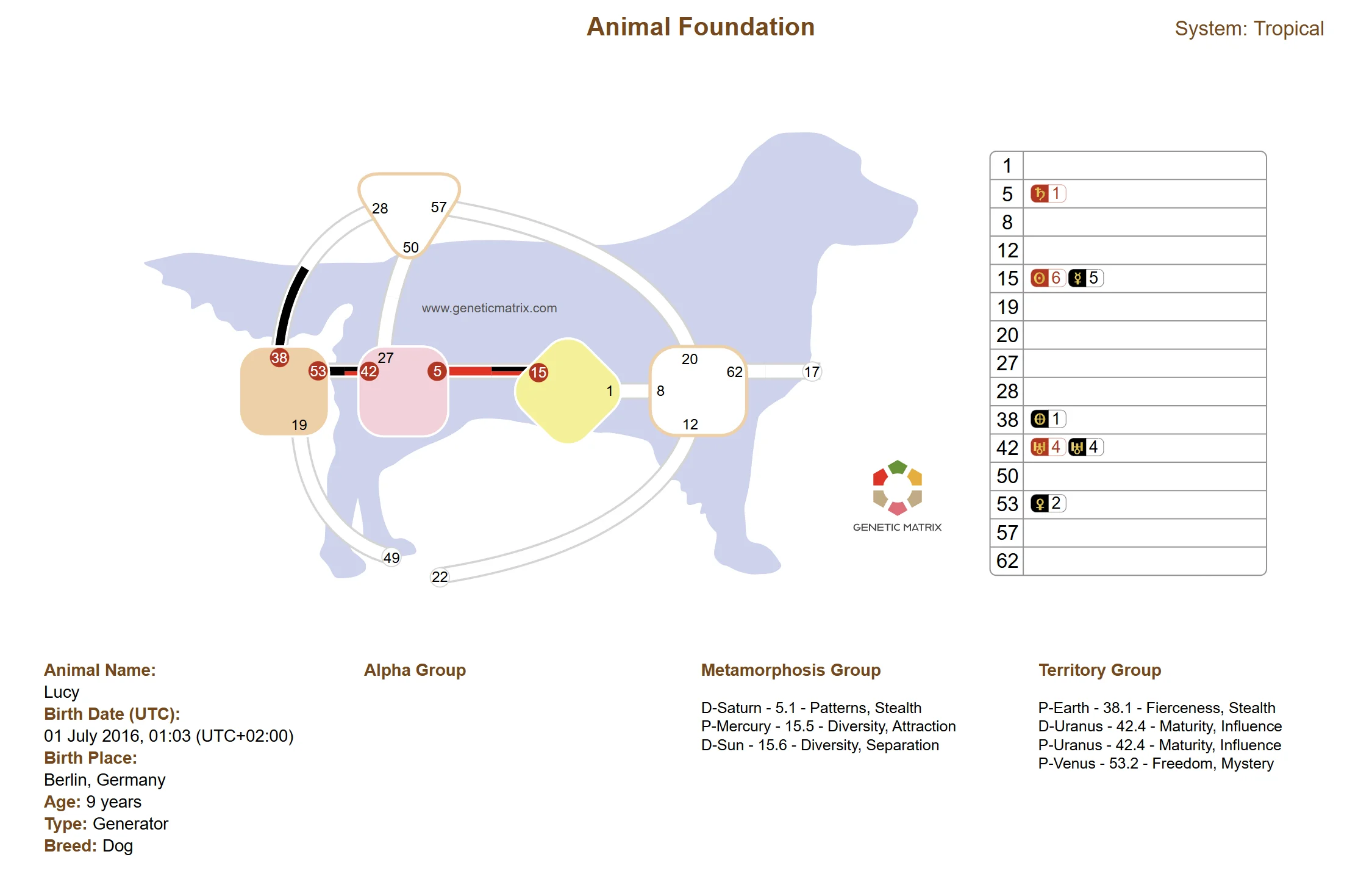
Example Animal Design chart. Click to enlarge.
| Frequently Asked Questions
What is Animal Design in Human Design?
Do I need my pet's exact birth time?
Why are most animals Reflectors?
How do I choose the right pet using Animal Design?
| Other Learn Topics
Sleep Design →
Your mammalian matrix during sleep. The same 15-gate system, applied to your own night programming.
Zodiac Signs →
How astrology maps to your Human Design gates, channels, and incarnation crosses.
The 5 Energy Types →
Generator, Projector, Manifestor, Reflector, and Manifesting Generator: your waking design.